
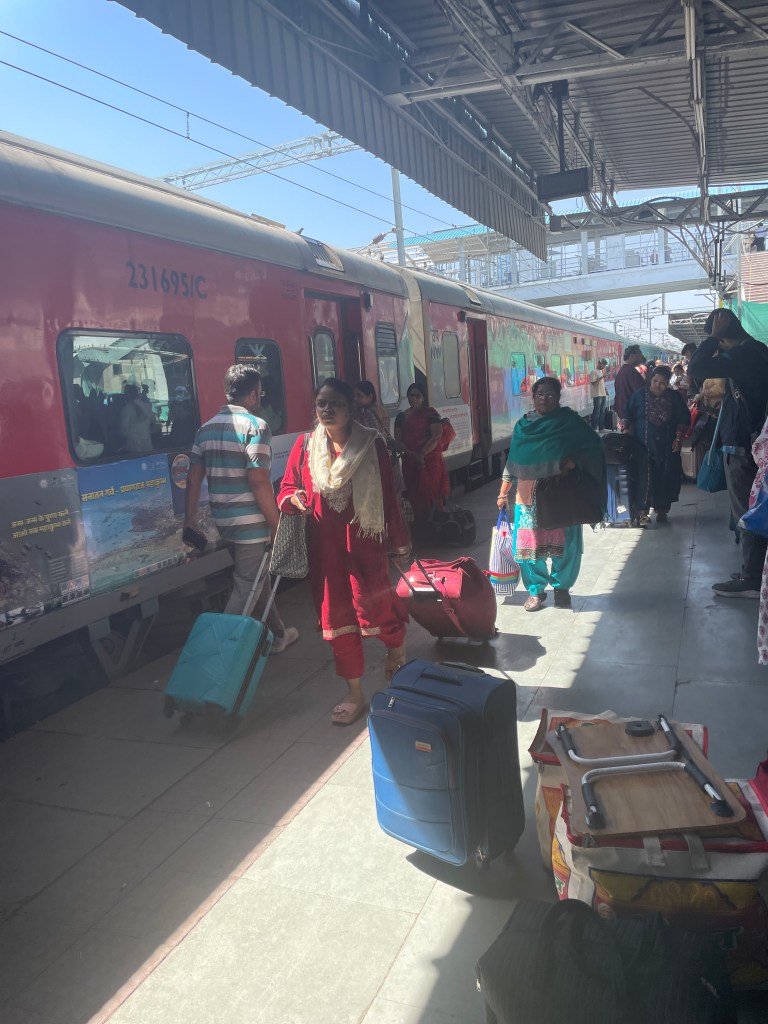
There are different classes in Indian trains. The coach in the picture above is the most economical class, hence metal bars in the windows. There is no air con in the cheapest coaches but you have access to fresh air.
If you are interested in traveling by train in India, you will find this post helpful. I have been finding my way round railway system in India for the past seven days and I thought I would document the whole process as this might be useful to other travellers. I am a solo female traveller and this has been my second trip to India. When I came to India first time I was based in Rishikesh for two months and I did my 500 hrs yoga teacher training there. My second time in India is a completely different experience. I travel, I move from place to place in Uttar Pradesh and Rajasthan. I came to Indira Gandhi International airport from London Heathrow. I stayed in New Delhi for two days and then went to Agra on the train. Next, I took the train from Agra to Varanasi. The train journey from New Delhi to Agra was short and lasted only three hours. However, the train from Agra to Varanasi was an overnight train, 655 km distance and 15 hours journey. I must admit that traveling by train in India can be an adventure and unforgettable experience. I am glad that I decided to give it a go. If you are a budget conscious traveller, trains in India might be a great option for you. They are safe and affordable. The booking process online is relatively straightforward. However, things can be a little bit confusing in the beginning. This is why it is important to search for some information first. I have made a list of most useful tips for people who have never travelled on the train in India but would like to try.
- Create your IRCTC account
Create your IRCTC account. When you register with IRCTC you will set up your own username and password. Once the registration is complete you will be able to book your train tickets directly from the official website using the e-ticketing system. IRCTC stands for Indian Railway Catering and Tourist Corporation. When you have a registered account you can track trains, cancel tickets, make PNR enquiries and claim refunds. Having a registered account is very convenient and cost effective. The link to the official IRCTC website is below:
https://www.irctc.co.in/nget/train-search
How to create IRCTC account as a foreigner?
Be prepared that it will take a great deal of patience and determination to create the account if you do not have Indian number and address. I set up the IRCTC account when I was still in the UK because I wanted it to be ready before my arrival to India but I remember that it took me couple of hours to create it. I had several failed attempts. But if I have managed to create successfully, you will be able to! It is very satisfying to be able to book train tickets directly from the official website, rather than through intermediary. Booking train and bus tickets through intermediaries always involves additional charges and costs.
2. Book your ticket early
Book your train tickets well in advance. Ideally, at least two weeks prior to your scheduled journey. Train seats in India fill up fast, therefore the sooner you buy your ticket the better. I have noticed that the seats for long-distance trains sell up faster. I had no problem to purchase a ticket from New Delhi to Agra three of four days before my journey but it was only 3 hrs journey. When I booked my ticket from Agra to Varanasi seven days prior to my journey I was placed on a waiting list and my position in the queue was 17. The journey from Agra to Varanasi lasts over 15 hrs. Luckily, closer to the departure day, 17 confirmed passengers must have cancelled their tickets because when I checked my PNR status two hour before the journey, I had an upper berth allocated to my name.
3. Know the name and number of your train
You can print you ticket or have a screenshot if it but it is also very handy to have the name and the number of your train written down. Train stations in India have LED information boards. These boards always display names of the trains and platform numbers. So if your train is called Shatabdi Express or Marudhar Express look for it on the information board. Once you spot your train name and its number on the information board you will see platform number displayed next to it too.
4. Come to the train station early
Train stations in India are very crowded and if you travel by train first time it is good to have plenty of time to learn how to navigate the train station. Trains in India are very long and made up of dozens of coaches. When I travelled from New Delhi to Agra, I had a seat number 23 in coach E1. When the train arrived on the platform, I had to literally run for at least three minutes to reach my coach. It seemed like coaches with letters A, B, C, D were just endless.
5. Familiarize yourself with train acronyms
Railway system in India uses lots of different acronyms and abbreviations. When I was booking my tickets for the first time I had to constantly look the abbreviations up. I attach the list of the most useful ones below:
- CAN: cancelled
- CNF: confirmed
- RAC: reservation against cancellation
- WL: waitlist
- RLWL: remote location waitlist
- PQWL: pooled quote waitlist
- RSWL: road side waitlists
- REL: released
- GNWL: general waitlist
- TQWL: tatkal waitlist
- UB: Upper berth
- LB: Lower berth
- MB: middle berth
- SU: Side upper berth
- SL: side lower berth

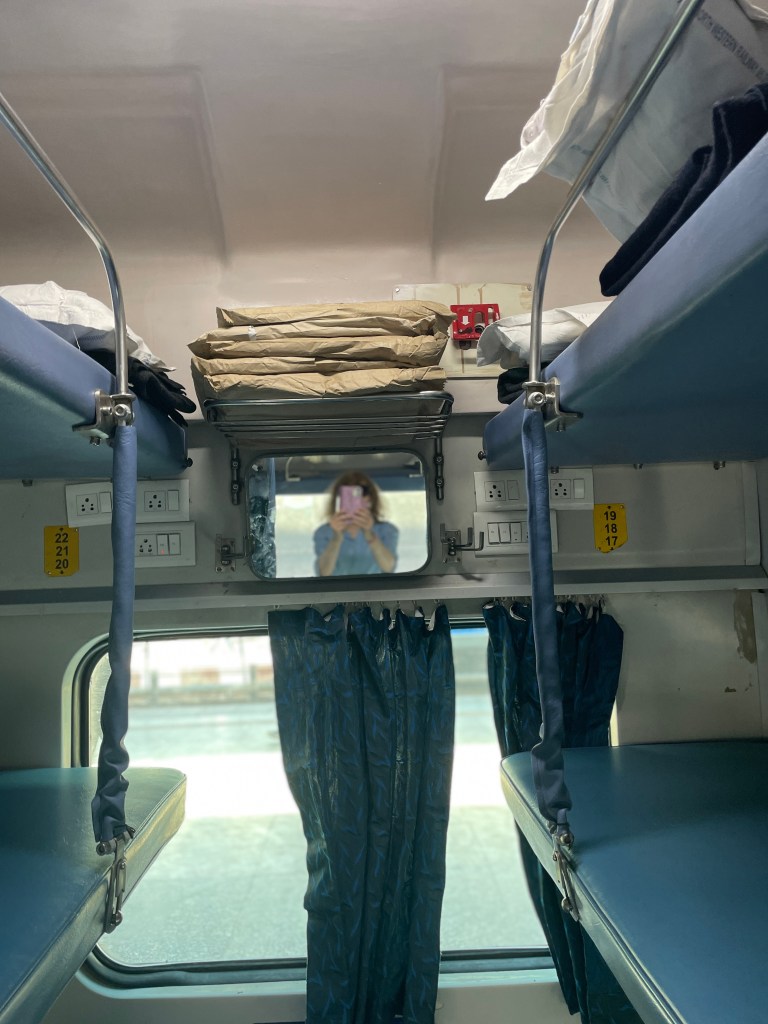
Lower berth, middle berth and upper berth. You can climb your berth using metal ladder on the side.

6. Book upper berth for long-distance travel.
If you travel long-distance it is best to choose upper berth. When you travel on an overnight train you do not want to be disturbed by other passengers. There is always way more commotion going on on the floor then under the ceiling. The train stops at different stations and food and water vendors enter the coaches and sell water, chai, snacks etc. When you are on the upper berth you have more peace and safety there. I felt safe on the upper berth. I kept my backpack up there with me. If you want you can stick your luggage under the bottom berth but make sure you take your valuables to your berth. The only inconvenience I experiences when sleeping on the upper berth was getting the attention of the food and drink vendors. They walk through the coach super fast and shout out “paanee, paanee, paanee! (water) or “samosas, samosas, samosa!” so it takes a bit of a reflex to catch them and buy something for them. If you want to get their attention and summon them to your berth, use the word “bairaa”!
I had the pleasure of traveling on the side lower berth only once but I was getting too much attention there. Families would stop to take selfies with me, some men would give intense stares. I suppose they were just curious about me and wanted to get to know me. However, I was very tired and I wanted to sleep. I covered my face with my hat and that’s how managed to get some sleep sleep on the lower berth. If you want to socialise then the lower berth might be the option for you. If you want to have more privacy and peace, opt for upper berth.
7. Bring a pillow cover and a bedsheet
If you travel long distance you will get a small pillow, sheet and a blanket. It is good to bring your own pillow cover and a duvet cover. You can put the blanket inside your own clean duvet cover. The coaches have air conditioning and it can get cold at night. If I had enough room in my backpacks, I would definitely bring a duvet cover.
8. Track your train using Ixigo app
Travelling long distance by train can be tiring. I remember waking up twice or three times during my overnight journey from Agra to Varanasi, being confused where I was. I used IRCTC option “track your train”. You can also use various tracking apps, such as Ixigo. Ixigo is very helpful because you can look up your platform number in advance. Being able to track your journey is very important. It is very reassuring to know where you are, the distance left and time remaining to the final destination, especially when you travel at night and all fellow passengers are fast asleep. Sometimes the trains arrive late, sometimes early, so tracking app is a must.
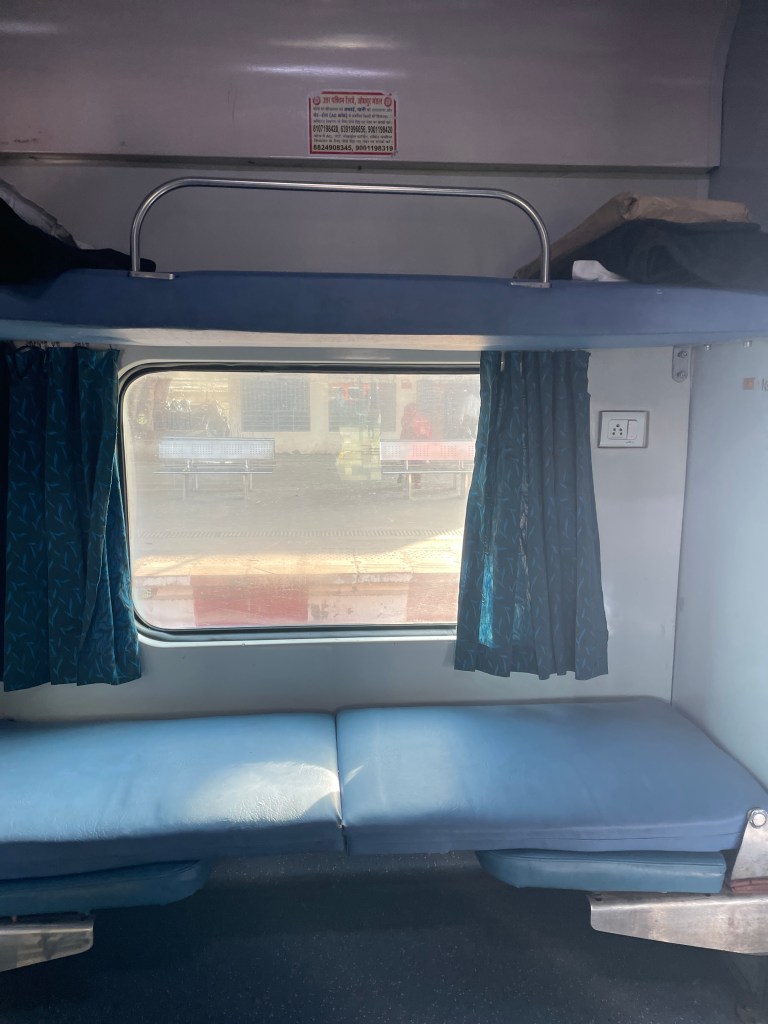
Lower side berth and upper side berth
If you don’t manage to get a berth when booking a train ticket, you might be placed on a waiting list or RAC. RAC is generally better that WL (waiting list) because it guarantees a shared seat. If you get RAC it means you can still travel but you will share a side lower berth (like the one in the picture above) with another passenger. Obviously, sitting up for many hours is not as convenient as being able to lay down on your own berth but at least you get a seat. I got RAC when I booked my train ticket from Varanasi to Jaipur, but then luckily RAC was converted to upper berth.
9. Take hand sanitizer and wipes with you
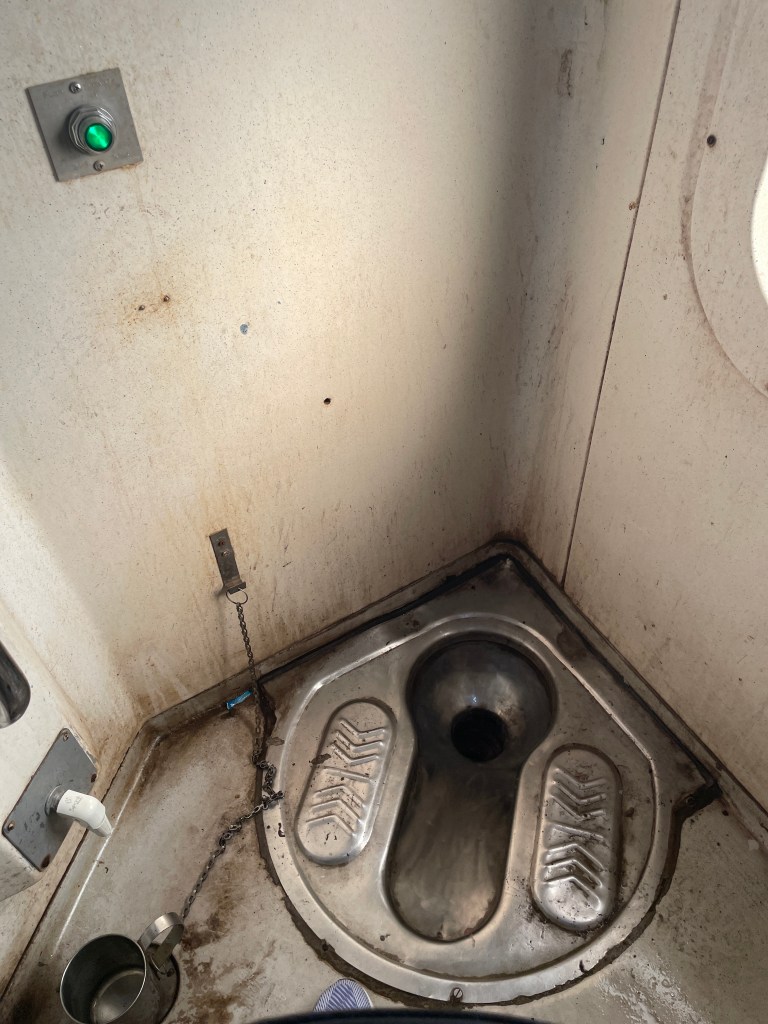
Some trains have both western style toilets and squat toilets. Some have squat toilets only. There is no toilet paper in the toilets. Be prepared for that.
10. Choose the right class
Let’s say you want to go to New Delhi from Udaipur now. The journey from Udaipur to New Delhi takes 12 hours. You will have a selection of four classes on the train:
Sleeper (SL) is the cheapest option. You are likely to pay ₹ 405 for 12 hour journey in a sleeper class. Sleepers are non-ac coaches and have 8 berths per compartment. The windows are not shielded with thick glasses unlike in AC coaches hence there is enough air ventilation.

AC 3 Economy (3E) cost for 12 hours journey – ₹ 1045
AC 3 Tier (3A) cost for 12 hours journey – ₹ 1060. I used AC 3 Tier class most often. It is very common, affordable and convenient. I felt very safe travelling in this class.

AC 2 Tier (2A) cost for 12 hours journey – ₹ 1490.
AC first class (1A) – cost for 12 hours journey – ₹ 2490. As you can see, first class is almost double the cost of AC 3 Economy class (3E). You could get a flight ticket for this price.


Waiting hall, train station in Varanasi

Train station in Agra
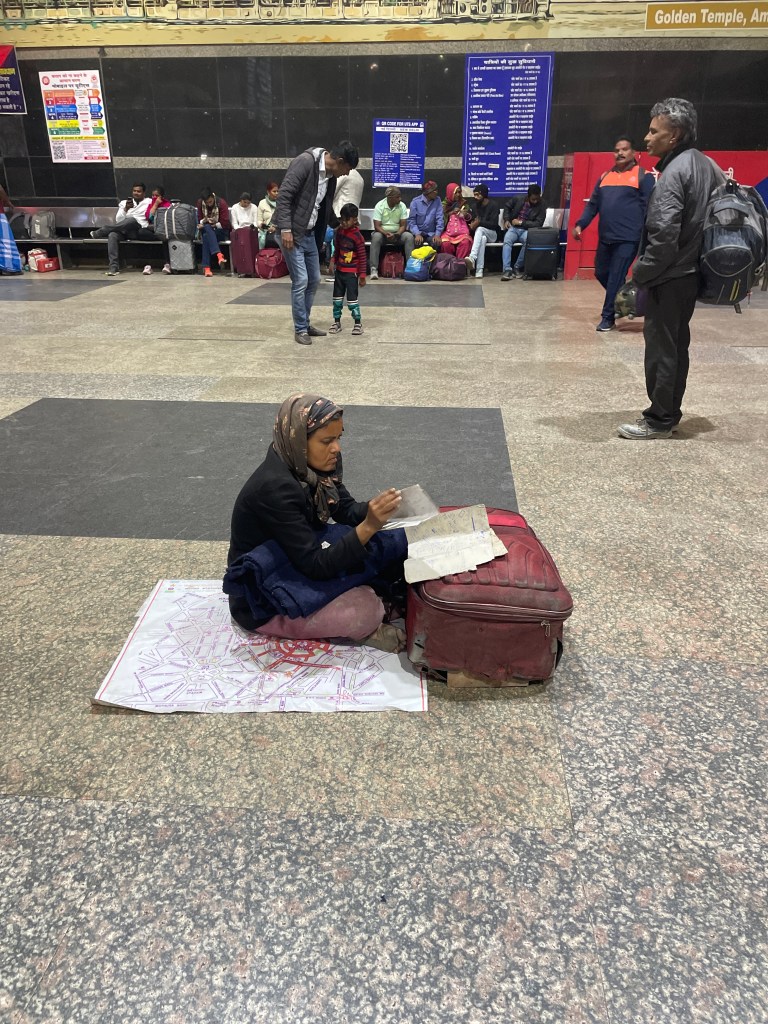
Train station in New Delhi
Travelling by train in India can be am amazing experience and a great adventure. I am still learning the ropes and will be sharing my discoveries with you. Thanks for reading.
 Autsie Explorer