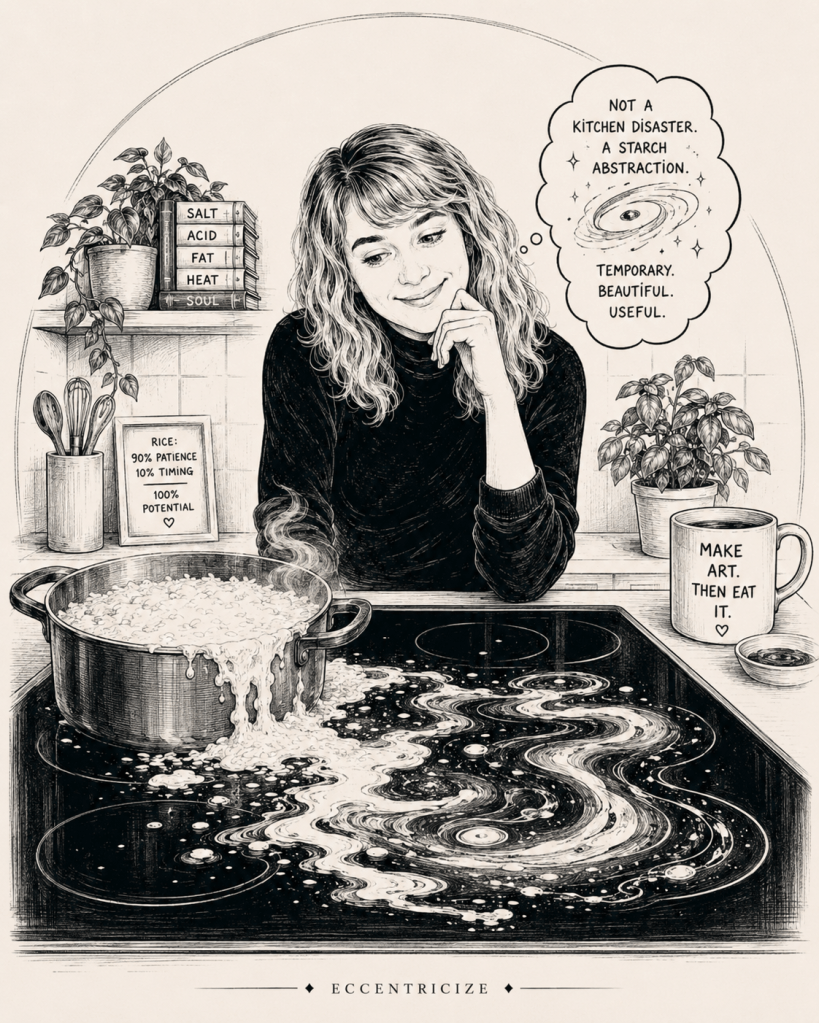
Today I was cooking rice. Nothing spectacular or glamorous. Nothing grand. Just rice — that humble staple food item that sits quietly in a pan, pretending not to be capable of rebellion.
Then the rice water escaped.
It bubbled up, lifted the lid, spilled over the edge of the pan and spread itself across my ceramic hob in pale, cloudy streaks. Previously, I might have reacted instantly. I might have felt irritation rising in me. I might have thought: Great, another mess. Another thing to clean. Another domestic inconvenience sent to test my already delicate nervous system.
But this time, something different happened. I did not see catastrophe. I zoomed in.
The spilled rice water had created strange patterns on the black surface of the hob: cloudy rings, white traces, little rivers of starch, accidental shapes that looked almost intentional. For a moment, the hob was not a dirty hob. It was a temporary abstract painting.
A domestic accident had become a visual event. And I thought: this is what it means to eccentricize life.
It is not always about dressing dramatically, creating art, inventing movement or writing grand declarations against dullness. Sometimes eccentricizing is much quieter than that. Sometimes it is the tiny inner shift between irritation and curiosity, between “this is a mess” and “this is a pattern,” between reacting and observing.
The world does not always need to change first. Sometimes our mindset and perception change.
The strarchy rice water was still there. The hob still needed cleaning. Practical reality had not been erased or annihilated. I had not floated into a parallel universe where housework no longer exists, although frankly, I remain open to that possibility. But my relationship to the moment had changed.
Instead of becoming angry, I became interested. Instead of seeing inconvenience, I saw composition. Instead of letting a small spill drag me into reactivity, I allowed it to become part of the unexpected artwork of everyday life. Reactivity takes seconds, proactivity requires a longer pause to slow down and reflect.
This is the kind of transformation I care about. Not fake positivity. Not pretending everything is wonderful. Not smiling at chaos like a deranged motivational poster. But developing the ability to pause, look again, and find some hidden texture or meaning inside the ordinary.
A spilled pan can be a nuisance. Or it can be an accidental abstract artwork that lasts three minutes before being wiped away.
Both are true.
The difference is the quality of attention.
Perhaps this is how a life becomes more artistic: not by waiting for perfect studios, perfect materials, perfect circumstances or perfect inspiration, but by allowing even the smallest domestic accident to reveal form, texture, mood and meaning.
Today, rice water escaped the lid. And instead of losing my temper, I found an abstract painting on the hob.
I think I am eccentricizing myself gloriously.
 Eccentricize
Leave a comment