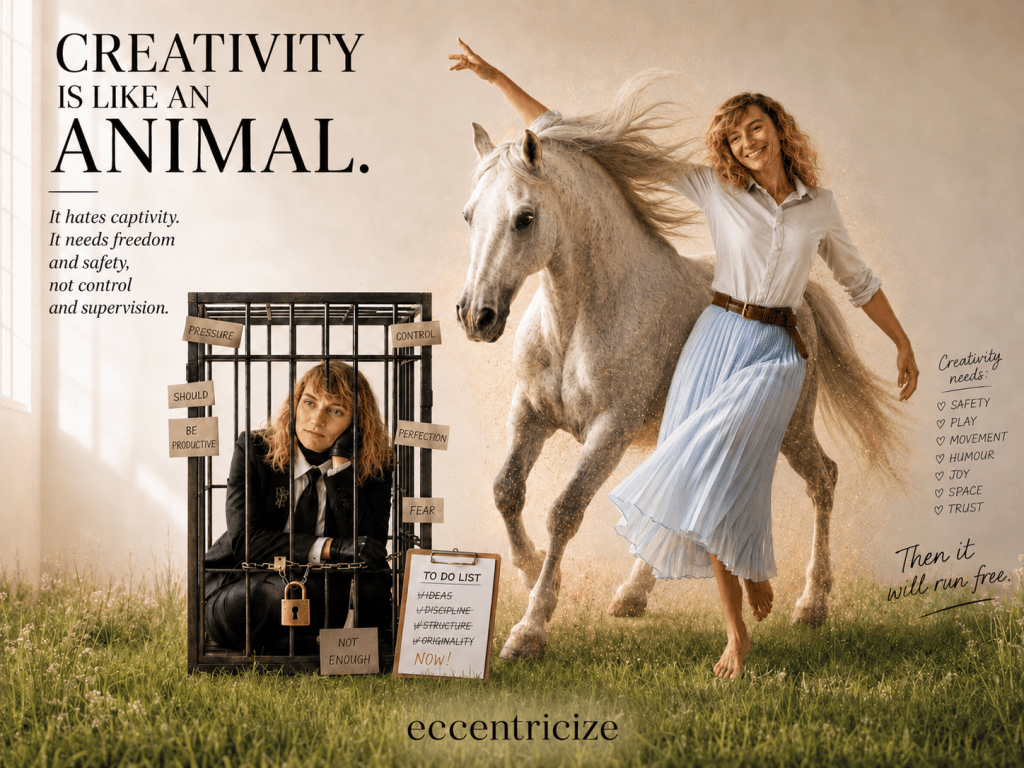
Many creatives try to unlock their potential through pressure. They sit at the desk as if reporting to a strict invisible manager. They demand ideas. They demand discipline and structure. They demand originality immediately. And then, very unsurprisingly, nothing significant arrives.
For years, I thought creativity required structure, self-discipline, deep focus, intensity, and possibly a tortured facial expression. I still believe in discipline, but I am beginning to understand that discipline without delight can turn into a cage or entrapment. The creative self is not a factory worker. It cannot be shouted into producing gold.
Recently I noticed something simple and profound: when I laugh, giggle, dance, hum, play, joke, chat light-heartedly with an intelligent mind, or turn my anxieties into satire, something inside me loosens. My nervous system stops guarding the palace gates. I become less afraid of coming across as silly. I return to movement, sound, rhythm, curiosity, humour and fun.
And then ideas start to flow.
A tune arrives while I am standing in the kitchen and making stir fry. A sentence appears. A new dance movement presents itself. A ridiculous metaphor becomes the beginning of a blog post. What looked like procrastination was sometimes the missing doorway: my creative force needed joy before it could risk expression.
This is not childish. It is the nervous system becoming safe enough to create.
But I do not want to romanticise lightness as something instant, cute or effortless. Before I reached this state — or even occasional glimpses of it — I had to pave the way through years of inner healing. Therapy, yoga, meditation, psychology books, self-observation, self-reflection, introspection, grief, recovery from childhood trauma: all of this came first. It took me approximately six or seven years to reconnect with the delightful child in me who used to dance, prance, hum and sing before she was ridiculed, silenced and shouted at by adults.
That child did not get silent because she ran out of creativity. She went into hiding because the world around her was not safe and gentle enough to receive her. Her natural aliveness became too bright, too strange, too inconvenient, too much. So, she learned to shrink, suppress, apologise, analyse and behave. Like many sensitive and creative children, she was not blocked because she did not know how to express herself. She was blocked because her self-expression had been dismissed as silly, childish and strange.
This is why I do not always trust the modern obsession with productivity hacks. They can be useful, of course, but they often ignore the deeper question: does the person feel comfortable and strong enough to create? You can buy the notebook, install the app, light the candle, schedule the writing hour and still sit there frozen if your inner child believes that expression will lead to ridicule, rejection or attack.
Many creative blocks are not caused by lack of talent. They are caused by fear, shame, pressure, perfectionism, social conditioning, comparison and the exhausting belief that we must produce something excellent before we are allowed to begin. But creativity often begins innocently, playfully, messily, almost foolishly. It begins as a hum, a scribble, a private dance, a sentence that may not survive the edit. It begins when we stop demanding a masterpiece and allow a little spark to appear.
If you feel blocked, do not immediately ask, “How can I force myself to work harder?” Ask instead: “How can I make my inner world feel safe enough to open?”
Laugh before you write. Turn your inner critic into satire. Walk or run before you plan. Dance before you judge. Make something absurd. Talk to someone who makes your mind brighter. Turn your fear into a character. Give your inner critic a clipboard and make it ridiculous. Let the heavy thing become theatre.
This does not mean avoiding discipline. It means preparing the fertile ground so discipline can work. A frightened nervous system experiences discipline as punishment. A safer nervous system can experience discipline as devotion.
There is a great difference between forcing yourself and inviting yourself.
Forcing says: create now, or you are useless.
Inviting says: come closer, little spark, I am open to let you in and embrace you softly and tenderly.
The lightness I feel now is not superficial. It is recovered life-force. It is the return of the self that was interrupted and stunted by unsupportive environment. It is the body remembering that movement can be joyful and liberating, the voice remembering that humming is comforting and nice.
Perhaps this is what it means to eccentricize one’s life: to stop treating your strangeness as a defect and start treating it as a signal. To stop amputating your quirks for the comfort of people who have mistaken numbness for maturity. To understand that your odd little rituals, your strange metaphors, your private dances, your sudden tunes, your laughter, your theatrical reactions and your unusual fascinations may not be distractions from your creative path.
They may be the path.
Creativity is not always unlocked by more effort. Sometimes it is unlocked by safety. Sometimes by satire. Sometimes by movement. Sometimes by the courage to become ridiculous again.
 Eccentricize
Leave a comment